
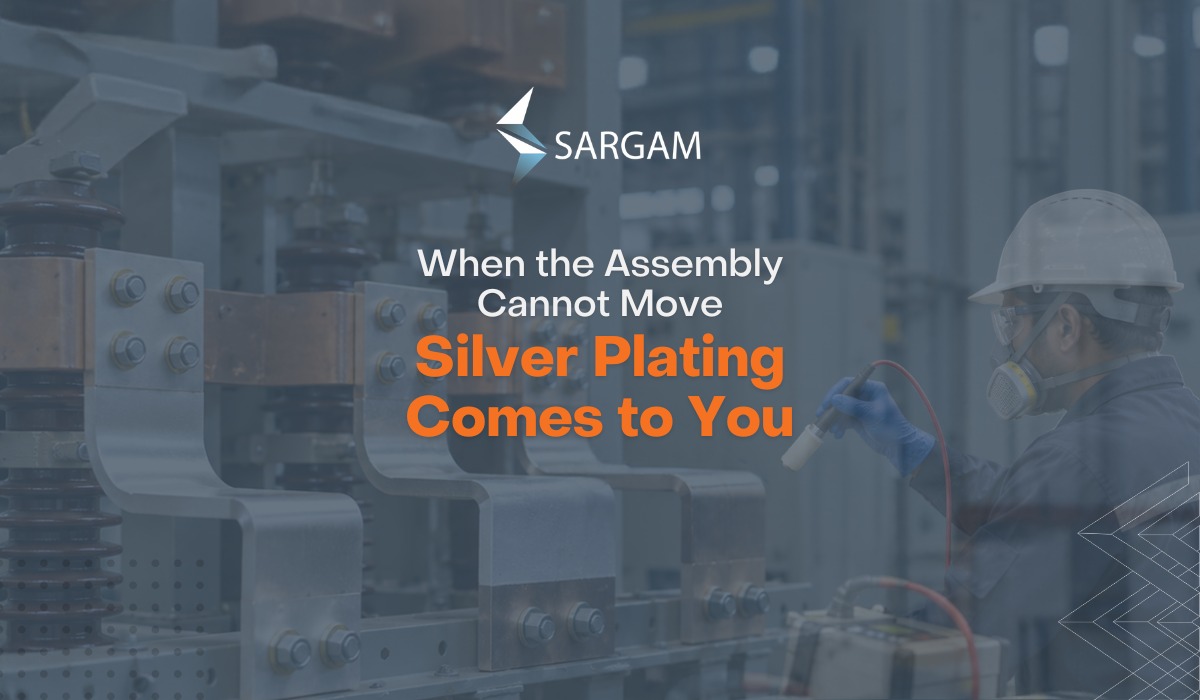
Not every component can be packed, transported and sent to a plating facility. Some assemblies are too heavy, some are too complex to dismantle, while others involve confidential designs and intellectual property that manufacturers cannot risk exposing.
But the need for silver plating still remains. In such situations, rather than moving the entire assembly, bringing the plating process to the component can be a more practical solution.
Why Onsite Silver Plating Makes a Difference
Silver plating plays an important role in electrical applications, particularly in switchgear, busbars and electrical contacts. Its excellent electrical conductivity helps reduce contact resistance and supports reliable electrical connections.
However, when these components are part of large or fully assembled equipment, conventional plating can become challenging. Dismantling an entire assembly just to plate a few critical surfaces may involve specialised labour, expensive transportation and considerable time. There is also the risk of damage during handling, transportation and reassembly.
Onsite silver plating addresses these challenges by allowing suitable surfaces to be treated at the customer’s premises, without having to move the complete assembly.
When Moving the Component Is Not an Option
In many industrial applications, the size and weight of an assembly make transportation difficult and expensive. Moving heavy electrical equipment may require cranes, specialised vehicles and additional safety arrangements. Onsite silver plating helps avoid these complications by allowing the component to remain where it is.
For complex assemblies, dismantling can be equally challenging. Taking equipment apart may affect its alignment or require extensive testing after reassembly. Selective silver plating, where technically feasible, allows specific accessible surfaces to be treated without disturbing the entire assembly.
Confidentiality is another important consideration. Some manufacturers work with proprietary designs and sensitive technologies that cannot be shared outside their facilities. Keeping these assemblies onsite helps protect intellectual property while allowing the necessary surface treatment to be carried out.
Beyond these advantages, reducing unnecessary handling and transportation can also minimise the risk of damage, control costs and reduce operational disruption.
Sargam Industries: Bringing Silver Plating Where It Is Needed
At Sargam Industries, we understand that every component comes with its own engineering challenges. Sometimes, achieving the required surface finish is not the difficult part. The real challenge is finding a way to carry out the plating process without affecting the assembly, compromising confidentiality or adding unnecessary costs.
Our understanding of electroplating and electrical engineering applications helps us appreciate why onsite solutions matter, particularly for large, sensitive and complex equipment.
Onsite silver plating is about more than convenience. It is about finding a practical way to meet surface treatment requirements while respecting the value, complexity and integrity of the equipment.
Because when moving the assembly is not practical, bringing silver plating to the assembly can make all the difference.